

Foot Down For Eton Fives
Alex Knight reports:
23/12/25: Since my appointment as the EFA’s first Chief Executive, the question I’m most often asked – usually in a kindly, sympathetic voice – is: “How’s it going?”
Eton Fives players are a generous-hearted bunch, but behind the genuine concern I can often detect another perfectly reasonable question: what exactly do I do, and to what end, especially now that the EFA’s seven-year development programme, FiveStar, has finished? In other words: “Where’s it going?”
The answer, at least in strategic terms, may be a little surprising: it’s going overseas. This article sets out why international opportunities matter and how, far from being a distraction, they can help support growth in the UK.
A Short History of Expansion and Contraction
As those familiar with the history of Eton Fives will know, international expansion is not a new concept:
“Eton Fives had spread well beyond its heartlands by the end of the 19th century… When EA Newaton became the Rector at St Paul’s School, Darjeeling, in 1898, one of the first building projects undertaken was Eton Fives courts; these were completed in 1899 and were the first to be built outside the British Isles.” A History of Eton Fives, Dale Vargas and Peter Knowles
As the game grew in popularity in the early 20th century, courts appeared in a range of countries, including Nigeria (1921), Switzerland (1923), Malaysia (1928) and Australia (1944). Although Eton Fives in Britain declined after the Second World War, the fact these courts were in schools – at Kano, Zuoz, Kuala Kangsar and Geelong – helped to keep the sport alive there. That link with education has always been, and remains, critical to the health of the game.
A FiveStar Impact
In the UK, however, the footprint of Eton Fives continued to shrink until the advent of the EFA’s FiveStar programme (2017-2024), which demonstrated two important things:
- Building facilities at schools new to Eton Fives is possible, as shown by the creation of three courts at Holyport College.
- Serious philanthropic support exists within the UK Fives community, with £1m+ raised in grants and donations for Holyport and other development projects.
The Fives community is passionate but relatively small, and after supporting both FiveStar and the Centenary Appeal, many donors quite understandably need a breather. Much still remains to be done, however, with coaching, outreach, construction and a host of other priorities all requiring further investment.
So the question becomes: how can the EFA generate sustainable, recurring revenue to meet these needs?
School Satellites
Over 20 years ago, Dulwich College began a trend that has since gathered pace across the independent sector: opening international satellite schools. Models vary, but the underlying rationale is straightforward: to generate income that supports bursaries and other charitable activities at the ‘home’ school in the UK.
With domestic demand under pressure, not least from the addition of VAT on school fees, more and more independent schools are branching out. Nearly a third of UK Fives-playing schools now have international campuses. The largest of these, the Harrow family of schools, has more than ten overseas sites, with Repton not far behind and others catching up (see Table 1).
Table 1: Overseas locations of Fives-playing schools
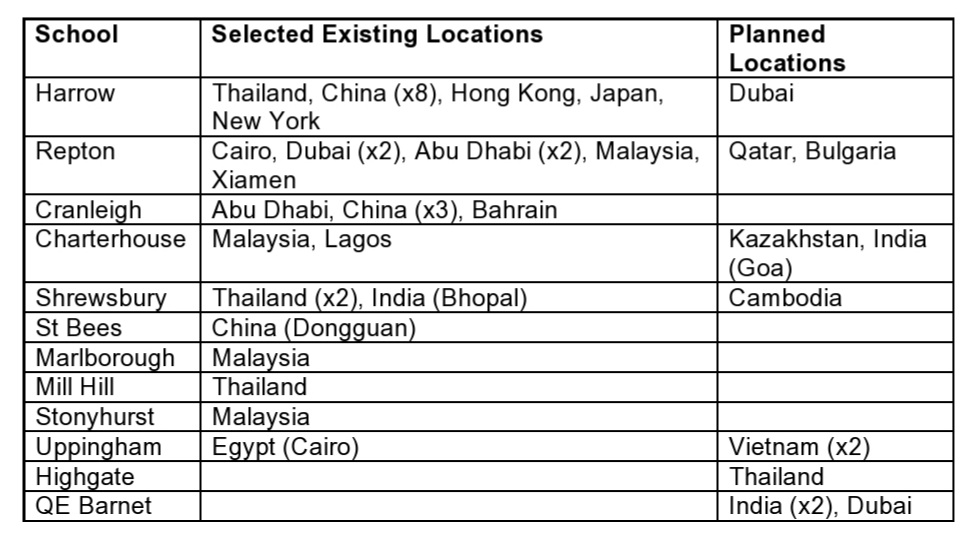
Such is the uptake that competition between school brands abroad can be as fierce as it is at home, and many are looking for an edge to help differentiate their offer to prospective overseas investors and parents. In a crowded international schools market, anything genuinely distinctive carries weight.
That is where Eton Fives comes in.
Why Eton Fives?
There are several reasons why the game is attractive to international markets:
- Heritage: a historic British sport associated with a select group of leading schools
- Accessibility: a unisex, non-contact game accessible to players of all ages and abilities.
- Space efficient: you can fit 12 EF courts on a single championship tennis court
- Value for money: capital costs can be depreciated over decades; low maintenance and minimal equipment required; a single, shared facility in co-ed settings.
For existing Fives-playing schools, the game can provide a unique and tangible link between the UK base and its satellites, as has already happened at St Bees Dongguan (2 courts) and will for Shrewsbury Phnom Penh (2 courts) when it opens in 2026.
Crucially, some of the barriers that constrain growth in the UK – the high cost of construction, a lack of demand and resources in schools, an elite heritage – are not factors in overseas markets.
So, if the demand exists, how do we meet it?
Rights and Licensing
This is new territory for the EFA and it is not yet entirely clear where the commercial sweet spot lies. The range of businesses and individuals involved means each situation will need to be considered on its merits.
What is clear is that the EFA’s limited resources mean we are most likely to operate a brand licensing model. The EFA will sub-license rights to third party suppliers who deliver products and services, with the EFA earning income through a royalty on revenue, similar to the arrangements many schools already use.
A rights package and/or membership subscription could include, for example:
- Licensing court designs and access to construction expertise
- Coaching frameworks, resources and, potentially, coaches
- Supply of kit
- Access to existing and future EFA tournaments and events
- Best practice advice, support networks, and shared resources.
It is important to be clear that the EFA does not intend to fund court construction overseas itself. Our role is to enable, not to build.
For those wondering how this fits with the EFA’s charitable status, we are explicitly following the example of our member schools, themselves charities, and will ensure any commercial income is collected and distributed appropriately. It is, in many ways, a strategy the schools have already road-tested for us.
And for the avoidance of doubt, pursuing commercial income is not mission drift; it is a necessity if the EFA is to sustain its charitable aims in the UK.
A Flying Start
Will this work for the EFA? Early signs are very encouraging.
I am already in discussions with the team overseeing Shrewsbury’s new campus in Cambodia about two new courts there, and there are also potential opportunities at satellites of Charterhouse and Repton. The Head of Sixth Form at Kellett School in Hong Kong, an Old Wulfrunian, even told me there was space for Fives courts around the edge of their sports pitch on the roof of their building!
Geographically, the most obvious initial focus is the United Arab Emirates, where there is already a cluster of Fives-playing school brands: Repton, Harrow, Cranleigh and Queen Elizabeth’s School all have campuses in either Dubai or Abu Dhabi (or both). The UAE has over 800 international schools, strong demand for elite British brands, and a centrally-driven emphasis on sport and wellbeing. Conditions there are especially favourable.
How the UK Will Benefit
As noted earlier, any income generated internationally will be used to support activities and projects in the UK. Our longstanding outreach commitment at Westway Sports Centre in West London, for example, no longer receives grant funding and needs a sustainable income stream to maintain it.
Beyond the direct revenue and the new players that overseas courts will bring into the sport, there are important knock-on benefits:
- Schools are more likely to renew their commitment to Fives at home, upgrading courts and increasing their use, if it is also part of their international identity.
- A larger global player base and more locations create more coaching opportunities, making UK-based coaching careers more viable.
- A higher international profile reinforces the game’s credibility and visibility in the UK, which helps when talking to schools, sponsors, donors and partners.
The EFA’s priority remains absolutely the support and development of the sport in the UK. As I hope is now clear, international growth is not a diversion of focus; it is a means of funding and future-proofing domestic success.
If you have any contacts or connections overseas that you think the EFA might benefit from, I would be delighted to hear from you at
Eton Fives has always travelled surprisingly well. With your support, it can travel even further.
Alex Knight